
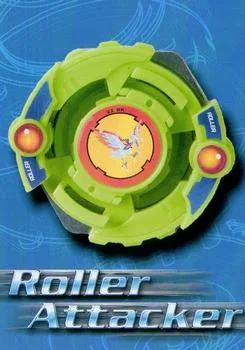
Pictured: Cards Inc. #63
Beyblade file · Plastic generation
Roller Attacker
Rōrā Atakkā · ローラーアタッカー
- Code
- 25
- Released
- February 2000 (Japan)
3
parts
2
cards across 2 games
Description
Released in Japan in February 2000 as part of the original 4 Layer System line, this Attack Type top combines the Roller Attack Ring with a Balance Weight Disk and a Flat Blade Base. An orange recolour turned up in Random Booster 1 ver. 2, with a further recolour following in Random Booster 2.
On file
The record
- Type
- Attack
- System
- 4 Layer System
- Series
- Next Generation Beigoma Battle: Beyblade
- Other code
- 25
- Released in Japan
- February 2000
- Japanese name
- ローラーアタッカー
- Romaji
- Rōrā Atakkā
Parts
- Attack RingRoller Attack Ring4.2 g
- Weight DiskBalance14 grams
- Blade BaseFlat8 grams
Open in the builder Swap any part and watch the stats move.
Part by part
Parts in detail
No further release history given.
| Slot | Part | Weight | Spin | Note |
|---|---|---|---|---|
| Attack Ring | Roller Attack Ring | 4.2 g | Right only | Built around rollers meant to reduce stamina/speed loss when the ring hits stadium walls without a Tornado Ridge; an asymmetric design (one side raised before the roller, the other recessed) with thin, breakage-prone sections. The resulting poor balance hurts its otherwise-plausible Defense/Survival role, and it has too much recoil for Compacts due to notches and an exposed face on one side; small size and poorly angled contact points rule out offense. |
| Weight Disk | Balance | 14.1 g | Light with an unremarkable weight spread; its large points and wider shape create recoil risk against low opponents. | |
| Blade Base | Flat Base | 6.5 g | Right only (built-in Spin Gear) | Very low profile lets it get under opponents, but it can't take a Heavy Metal Core, ruling out Traditional Upper Attack use; light weight and modest grip limit recoil control, and it's somewhat hard to keep in a flower pattern. Decent Life-After-Death gives it a role similar to Semi-Flat Base Stamina setups, best paired with Wide Defense and a compact or small defensive ring. |
Weights are single copies weighed on their own; a part can vary by a few tenths of a gram.
Colours & Versions 2
2 recolours.
| Version | Kind | Colours |
|---|---|---|
| Random Booster 1 ver 2 | Recolour | Orange |
| Random Booster 2 | Recolour | ??? |
In play and in the story
- Released in Japan in February 2000.
- Recoloured in orange for Random Booster 1 ver. 2.
- Recoloured again for Random Booster 2.
Community testing, Aug. 05, 2012 — summarised
The competitive view
Roller Attacker's thick, rigid-edged attack ring is fitted with two rollers meant to deflect an opponent, but the gimmick is considered to fail because most of the energy from a hit just spins the rollers instead of landing a knockout; the ring performs better defensively, thanks to its round, compact shape, than as the attack piece it was designed to be. The roller gimmick is regarded as a likely misstep from an experimental phase of the toy line, since no later release repeated it.
Condensed from community testing; competitive opinions are the community's, not ours, and may be out of date.
In the card games
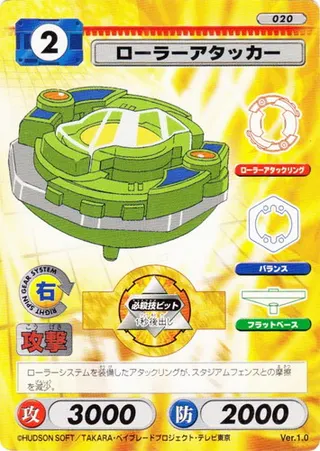
Roller Attacker on cardboard
More from the 4 Layer System
- 4 Layer System · 2000 Dranzer Auto Change Balancer Balance · Takara Tomy
-
 4 Layer System · 2000 Roller Defenser Defense
 -
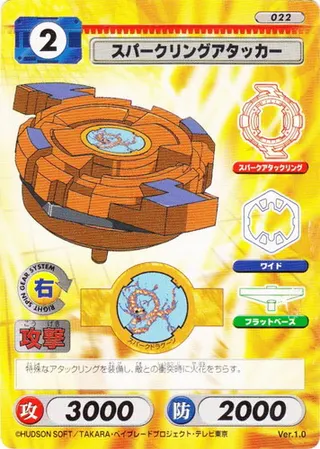 4 Layer System · 2000 Sparkling Attacker Hasbro
 -
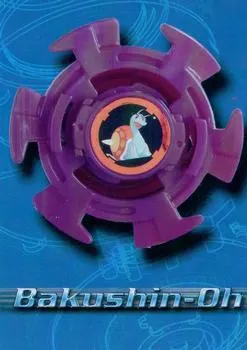 4 Layer System · 1999 Bakushin-ou Defense
 -
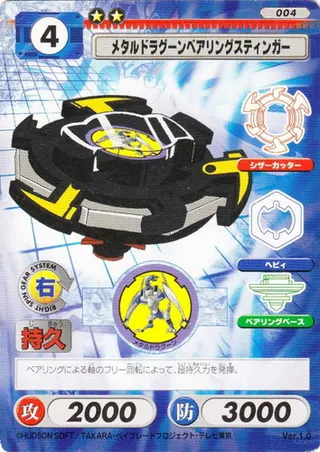 4 Layer System · 1999 Bearing Stinger Stamina · Takara Tomy
 - 4 Layer System · 1999 Bistool Balance
-
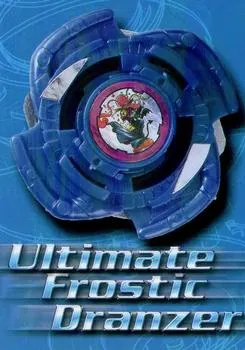 4 Layer System · 1999 Frostic Dranzer Balance
 -
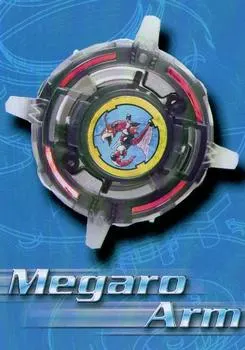 4 Layer System · 1999 Megalo Arm Attack