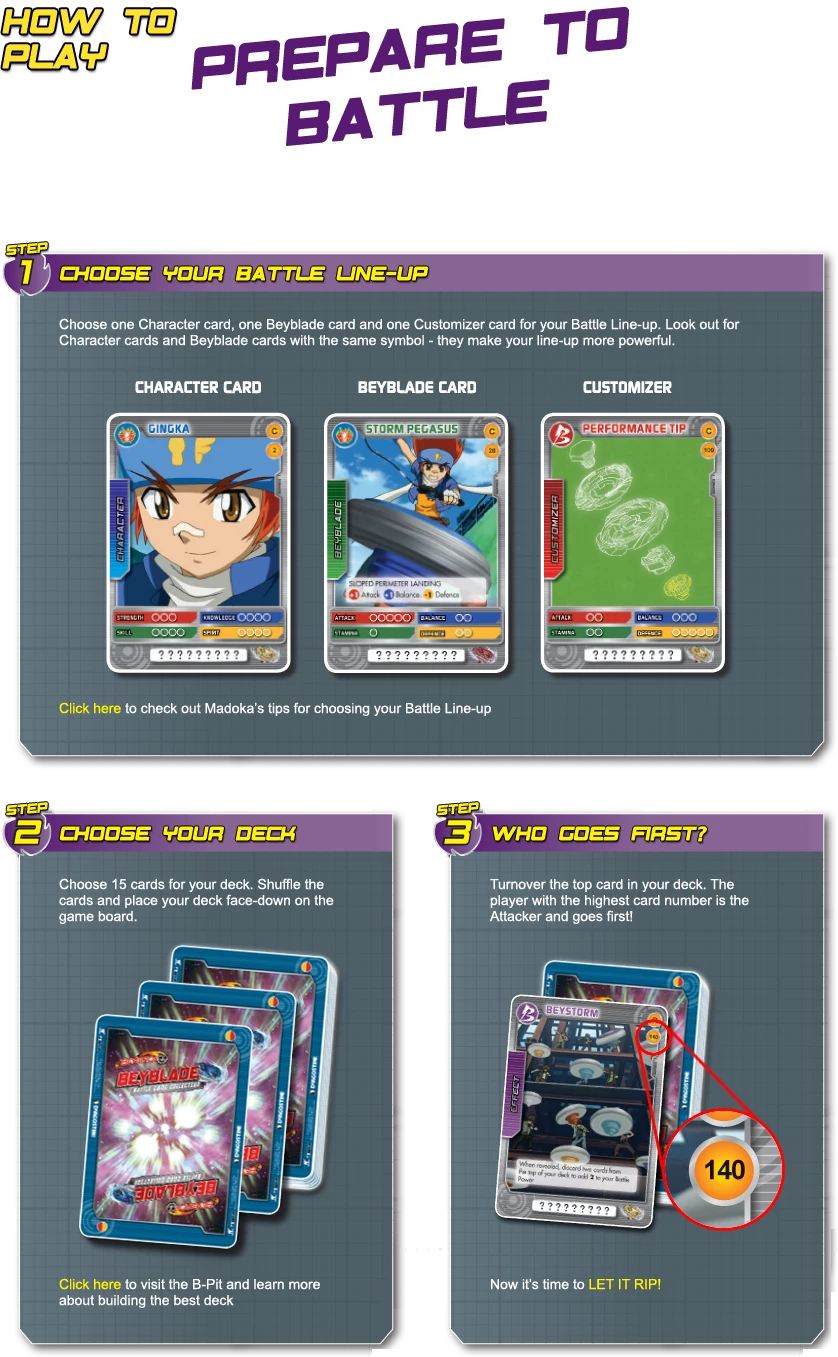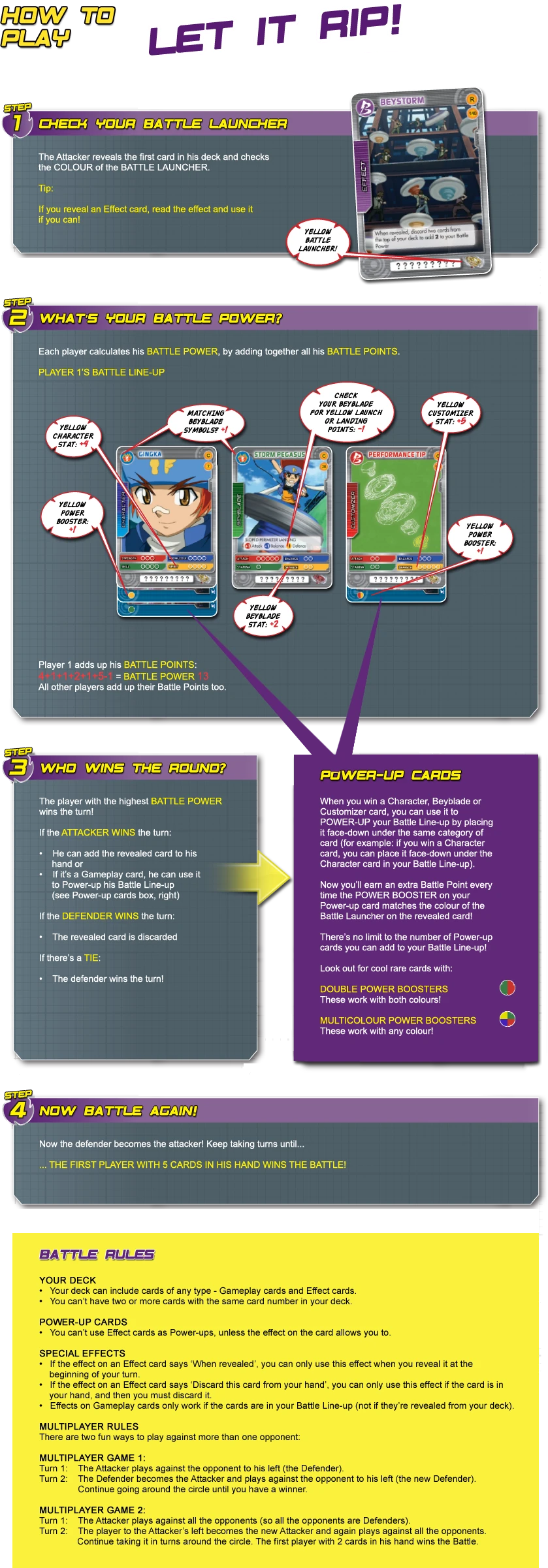
DeAgostini never printed a rulebook. The whole game was explained on two pages of its own website, Prepare to Battle and Let It Rip!, and when beybladecards.com went down in 2013 they went with it. Both pages are at the foot of this one; what follows is them, in plain English.
1. Build your battle line-up
Before the deck comes out, each player lays three cards face up: one Character, one Beyblade and one Customizer. That trio is the line-up, and its printed stats are what you will score with all game long. Two details matter when you pick them. First, Character and Beyblade cards carry a small emblem in the top-left corner; a matching pair, say Gingka with Storm Pegasus, adds a point every time battle power is counted. Second, Beyblade cards name a launch or landing move with a short row of plus-or-minus values, each printed in a colour, and the value in the turn’s colour is applied.
2. Build a deck of fifteen
Each player then shuffles fifteen more cards into a face-down deck. Any type is allowed, gameplay cards and Effect cards alike, but you may not run two cards with the same number. Each player turns over the top card of the deck once; the higher card number attacks first.
3. Reveal, read the colour, add it up
The attacker reveals the top card of their deck. Every card carries a battle launcher in its bottom corner, a small spinning top printed in a colour; the rules pages show the same four colours as the stat rows, red, blue, green and yellow. That colour sets the turn. If the revealed card is an Effect card, its text applies now, if the player can use it.
Now everyone counts their battle power from the line-up: the stat of that colour on the Character card, the stat of that colour on the Beyblade card, the stat of that colour on the Customizer card, plus one for a matching Character and Beyblade emblem, plus or minus the Beyblade card’s launch or landing value in that colour, plus any power boosters sitting under the line-up (see step 5). The rules’ own worked example, on a yellow launcher, adds four from Gingka’s yellow row, one for his emblem matching Storm Pegasus, two from the Beyblade’s yellow row, five from the Customizer’s, one each from two boosters under the line-up, and takes one away for the Beyblade’s yellow landing value: thirteen.
4. Who wins the round
The higher battle power takes the turn. A tie goes to the defender. If the attacker wins, the revealed card is theirs: it can go into the hand, where it counts towards victory, or, if it is a Character, Beyblade or Customizer, it can be used as a power-up. A defender’s win sends the revealed card straight to the discard pile. Then the roles swap and the other player reveals.
5. Power-up cards
A won gameplay card can be slid face down under the line-up card of the same type: a Character under your Character, and so on. From then on it is a power booster. The rules pages show the booster as a small coloured circle on the back of the card, which is why a face-down power-up can still be read; whenever its colour matches the launcher colour of the turn, it adds one point. Nothing caps the pile, so a long game snowballs. The rules page says to look out for rarer cards with double boosters, split between two colours and firing on either, and multicolour boosters that fire on every colour; which cards carry them is not yet sourced. Effect cards cannot be used as power-ups unless their own text says so.
6. Winning
Turns alternate until one player holds five cards in hand. That player wins the battle. Because only the attacker can gain a card, and only by winning the turn, the whole game is a race of attack turns.
7. The fine print
- An Effect that says when revealed works only at the moment its owner reveals it from the deck.
- An Effect that says discard this card from your hand works only from the hand, and the card is then discarded.
- Printed effects on Character, Beyblade and Customizer cards apply only while those cards sit in the line-up, not when they are revealed from the deck.
- No duplicate card numbers in a deck.
8. More than two players
Two variants were printed. In the first, the attacker plays against the player on their left; the defender then becomes the attacker against the next player round the circle, and so on until someone reaches five cards. In the second, the attacker plays against everyone at once, the next player round the circle attacks next, and the first player to two cards in hand wins.
Reading a card
The band down the left edge names the type. Beyblade and Customizer cards print four stats, attack, balance, stamina and defence, as rows of up to five pips in red, blue, green and yellow; Character cards print strength, knowledge, skill and spirit in the same four colours. Those colours are the launcher colours, which is how a revealed card tells you which row to read. The circle in the top-right corner carries the rarity letter, with the card number below it; the white box at the foot hides a code for the game’s website, and the launcher top sits beside it. What entering that code unlocked is not yet sourced; the two rules pages only point to a deck-building section of the site they call the B-Pit, and to Madoka’s tips on choosing a line-up.
Every card of the game is on the card list with its stats and abilities, and the packs, blisters and box show how it was sold.